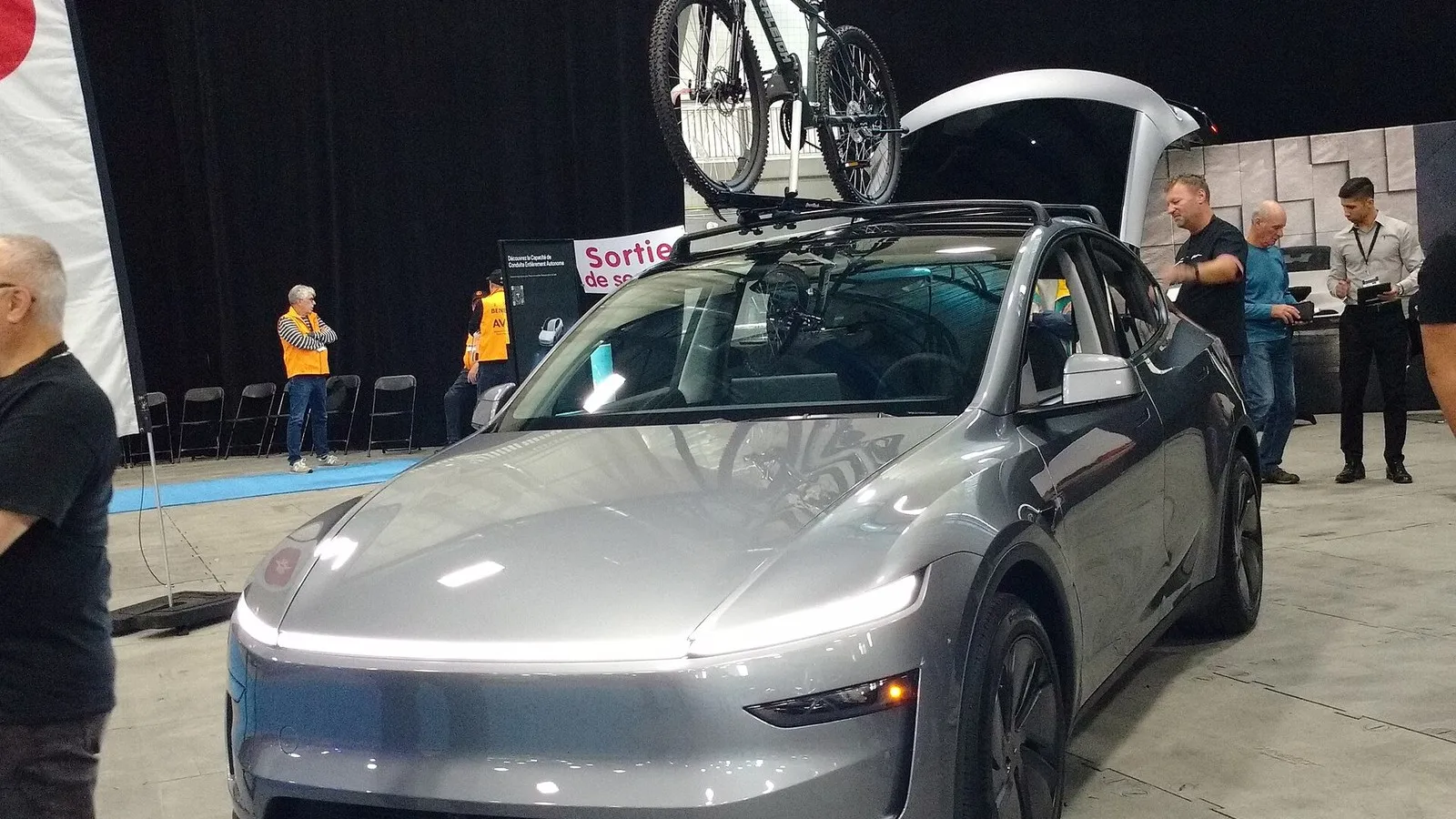
Europe's independent car-sustainability tester has given the Tesla Model Y its top rating. On October 29, 2026, Green NCAP published a five-star Sustainability Rating with an overall score of 93% for the Model Y Rear-Wheel Drive, a Berlin-built car (Green NCAP press release). Its life-cycle greenhouse gas figure of 95 g CO2-eq/km is, in Green NCAP's words, "the lowest value published by Green NCAP so far" (Green NCAP Model Y assessment). Tesla Europe made the same point on X the same day (Tesla Europe on X).
What did Green NCAP rate?
Green NCAP is a European testing programme that rates how clean and efficient new cars are. Since 2025, its ratings include a life-cycle assessment that counts emissions from making the car and its battery, from producing the electricity or fuel it uses, and from scrapping and recycling it (Green NCAP assessments). In its October 2026 round, it rated the Model Y Rear-Wheel Drive, which it lists as a small SUV with 220 kW, a mass of 1,914 kg, a heat pump, and a declared European (WLTP) range of 534 km (Green NCAP assessment).
The car scored 93% overall and five stars. Green NCAP also called it one of only two cars so far rated "good" for both consumption and range and cold-winter performance (same source).
Green NCAP: Tesla's verified data led to "the lowest value published by Green NCAP so far: 95 g CO2-eq./km."
Why is the CO2 figure so low?
Green NCAP says it's mostly down to data. Instead of using its usual generic assumptions about how a car is built, it used manufacturing data that Tesla supplied for the car and its battery, which Green NCAP's experts reviewed and verified (press release). Green NCAP says Tesla's steps to cut emissions from vehicle and battery manufacturing are "effective," and that the calculation takes into account the car's manufacturing in Germany (assessment).
The result, 95 g CO2-eq/km over the car's life, is the lowest greenhouse gas figure Green NCAP has published so far and well below the 110 g threshold needed for full marks. For comparison, Green NCAP rated the Volkswagen Tayron 1.5 eTSI, a slightly lighter petrol mild-hybrid SUV, at 263 g CO2-eq/km, 2½ stars and 41% in the same round (press release; assessments list).
How did the Model Y do in the cold?
Green NCAP tests at −7°C, which makes this the part of the report most worth a look for Canadian drivers. It rated the Model Y "good" for cold-winter performance (Green NCAP assessment):
- The cabin reached its 16°C target in 4 to 8 minutes, depending on the seat.
- Locked and left at −7°C for 30 minutes, the cabin lost only 5.2°C. Green NCAP's press release calls the cabin "impressively well-insulated".
- Quick heating costs energy. In the −7°C cold-start lab test, the car used 30.5 kWh/100 km, against 13.1 kWh/100 km in the standard WLTP test.
- Pre-warming the car before a cold trip added an estimated 101 km of range on a mixed trip and 136 km on an urban trip, and Green NCAP advises owners to do it.
- Green NCAP's estimated real-world range on a mixed trip was 449 km in warm weather and 274 km in cold winter conditions.
How fast does it charge?
Green NCAP timed a 10% to 80% DC fast charge at under 24 minutes, with an average of 115 kW and a peak of 187 kW. Home charging on an 11 kW AC charger was 88.7% efficient from grid to battery, which it rates "adequate" (Green NCAP assessment). The tested car has no bidirectional charging (no vehicle-to-load, vehicle-to-home or vehicle-to-grid), which Green NCAP scores as "poor" (press release).
What are the caveats?
- It's a European assessment. Green NCAP's life-cycle numbers assume a 16-year life, 240,000 km of driving and a forecast of the average electricity mix of the 27 EU member states (Green NCAP: LCA explained). The 95 g figure isn't a Canadian number.
- It isn't the top overall score. In the same round, the BYD Dolphin Surf scored 96% and five stars (press release). The Model Y's 95 g is the record; its 93% overall is not.
- No comparisons with older ratings. Green NCAP says its 2025 scheme is so different that ratings from earlier years can't be directly compared (Green NCAP assessments).
- One car, one trim. The rating covers the European Model Y Rear-Wheel Drive Green NCAP tested, not every Model Y.
What does it mean for Canadian Model Y owners?
Green NCAP doesn't test cars for the Canadian market, so treat the score as a useful independent look at the car rather than a Canadian rating. The cold-weather and charging results are the most relevant here. For more on Berlin's output, see our Giga Berlin story. For living with a Model Y here, see our Model Y Standard review, winter driving guide and which Tesla to buy in Canada. For the Canadian car's rated range and efficiency, see our Model Y Standard specs.